The first page of your memoir determines whether readers will stay for your entire story.
Disclosure: Some links above may contain affiliate partnerships, meaning, at no additional cost to you, Publish and Promote may earn a commission if you click through to make a purchase. You can read our affiliate disclosure in our privacy policy.
After guiding over 300 writers through the memoir process, I’ve discovered something crucial: the most compelling openings don’t begin at the beginning—they begin at the moment everything changed.
Here’s what separates memoirs that get read from those that gather dust: they immediately immerse readers in a scene that matters, not a chronology of facts.
Let me show you seven proven techniques that transform ordinary life stories into page-turners.
Writers often use “memoir” and “autobiography” interchangeably, but they’re fundamentally different books with distinct purposes, structures, and audiences. Understanding this distinction will shape everything from your writing approach to your marketing strategy—and determine whether your book actually gets read.
After guiding over 300 writers through their life stories, I’ve seen countless people start writing an autobiography when they should be writing a memoir. Here’s how to know which one you should write.
What Is the Difference Between Memoir and Autobiography?
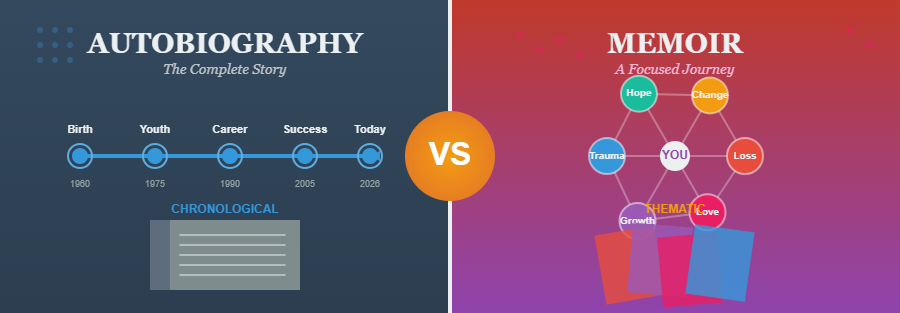
An autobiography covers your entire life chronologically, from birth to present day. Think of it as a comprehensive life record—a biographical timeline that documents where you were born, who your parents were, where you went to school, your career progression, significant relationships, and major life events in the order they occurred.
Benjamin Franklin’s autobiography walks through his whole existence—childhood, career, inventions, political life. It’s exhaustive and chronological.
A memoir focuses on a specific theme, period, or slice of experience from your life. It’s selective and thematic, diving deep into particular moments that shaped you rather than cataloging everything that happened to you.
Cheryl Strayed’s Wild doesn’t cover her whole life—just her transformative 1,100-mile hike on the Pacific Crest Trail after her mother’s death, her divorce, and her struggle with addiction. That’s a memoir: one experience explored deeply.
Memoir vs Autobiography: Scope and Structure Differences
How Autobiographies Are Structured
Autobiographies follow a strict chronological timeline. You start at the beginning (often literally with “I was born…”) and move forward through your life in order. They aim for completeness, documenting major life events systematically:
- Birth and early childhood
- Education
- Career milestones
- Relationships and family
- Achievements and failures
- Present day and legacy
The autobiography asks: “What happened in my life, and when?”
How Memoirs Are Structured
Memoirs jump around in time strategically. You might open with a powerful moment at age 40, flashback to childhood experiences that explain it, then return to present day. The structure serves the theme, not the calendar.
The memoir asks: “What does this experience mean, and how did it change me?”
A memoir about overcoming alcoholism might open with your rock bottom moment, weave in relevant childhood memories that explain your relationship with drinking, skip entirely over unrelated life events (your college major, your first apartment, jobs that don’t connect to the theme), and end with your transformation.
Who Should Write a Memoir vs Autobiography?
Can Anyone Write an Autobiography?
Here’s the uncomfortable truth: autobiographies typically require existing fame or significant public recognition.
People buy autobiographies to learn about notable figures—presidents, celebrities, business titans, historical figures, cultural icons. Unless you’ve achieved recognition beyond your immediate circle, publishers and readers expect a memoir instead.
Ask yourself honestly: Would strangers pay $20 to read about my entire life? If the answer is no, you’re writing a memoir.
Who Can Write a Memoir?
Memoirs are beautifully democratic. Anyone with a compelling story and honest voice can write one. You don’t need fame; you need a meaningful experience others can connect with:
- Overcoming addiction or illness
- Surviving loss or trauma
- Navigating cultural identity or immigration
- Building something from nothing
- Leaving a religion or cult
- Raising a child with special needs
- Transforming your career or life at midlife
- Living through historical events
The memoir reader doesn’t ask “Who is this person?” They ask “Can I relate to this experience?”
How to Find Your Memoir Theme
If you’re writing a memoir, you must identify your central thread. What’s the one thing your book is really about?
Elizabeth Gilbert’s Eat, Pray, Love is about finding herself after a devastating divorce. It’s not about her entire life—just one year of intentional healing across three countries.
Trevor Noah’s Born a Crime explores growing up mixed-race under South African apartheid. It’s not about his comedy career or current success—it’s specifically about navigating an identity that was literally illegal.
Your Life Contains Multiple Potential Memoirs
This is crucial to understand: your life likely contains several possible memoirs, but each one needs to be its own focused book.
Your cancer journey is one memoir. Your immigration story is another. Your career transformation is a third. Your relationship with your difficult mother is a fourth.
Pick one angle and explore it fully rather than trying to squeeze everything into a single book. You can always write another memoir later.
Here’s how to identify your memoir theme:
- What period or experience do you think about most often?
- What story do you find yourself telling at dinner parties?
- What part of your life taught you the most important lesson?
- What experience would you want to share if you knew it could help someone else?
- What theme keeps appearing in your life’s turning points?
That’s your memoir.
Memoir or Autobiography: Which Should You Write?
Choose Autobiography If:
✅ You’ve achieved significant public recognition (bestselling author, major political figure, celebrity, industry titan)
✅ Your entire life story holds documented broad interest (publishers have already approached you, or you have a substantial existing platform)
✅ You want to create a comprehensive legacy document for historical record
✅ Multiple major life achievements across different fields warrant full chronological coverage
Choose Memoir If:
✅ You’re an everyday person with an extraordinary experience worth sharing
✅ You have a specific story that carries universal themes (transformation, survival, identity, love, loss, resilience)
✅ You want readers to feel something and see themselves in your journey, not just learn facts about your life
✅ Your most powerful story centers on a particular period, relationship, challenge, or transformation
✅ You’re writing to help, inspire, or connect with readers facing similar experiences
Still unsure? If you’re reading this article, you’re almost certainly writing a memoir, not an autobiography.
The Publishing Market Reality: Why Memoirs Sell Better
Publishers heavily favor memoirs over autobiographies from non-celebrities—and for good reason. Memoirs outsell autobiographies among general readers because they promise transformation and relatability rather than just information.
Why Readers Choose Memoirs
Readers pick up memoirs to:
- Find hope that they can overcome similar challenges
- Feel less alone in their experiences
- Learn from someone else’s transformation
- Experience another culture or world
- Process their own trauma or loss through your story
They’re seeking emotional connection and meaning, not a chronological catalog of someone else’s life events.
Cross-Category Appeal of Memoirs
Bookstores stock memoirs in multiple sections, expanding your potential audience:
- Addiction memoirs appear under self-help and recovery
- Travel memoirs sit in the travel section
- Food memoirs land in cooking and culinary
- Business memoirs live in entrepreneurship and leadership
- Parenting memoirs fill the family section
This cross-category placement means your memoir reaches readers browsing different interests—all connected by your central theme.
How to Start Writing Your Memoir or Autobiography
Stop worrying about perfectly labeling your project right now. Instead, start with the story that won’t let you go.
What’s the burning experience you need to share? The period that changed everything? The relationship that shaped who you became? The challenge you overcame that taught you something essential?
Write that first. Write the story you’d tell if you had one hour to share the most important thing you’ve learned from living.
The category—memoir or autobiography—will become crystal clear as your narrative takes shape. The structure will reveal itself through your material.
Common Mistakes When Starting Your Life Story
❌ Starting with “I was born…” unless your birth itself is central to your memoir’s theme (like Trevor Noah’s, since his birth was literally a crime)
❌ Trying to include everything instead of focusing on your central theme
❌ Writing chronologically when your story would be more powerful told thematically
❌ Waiting until you’re “old enough” to have a complete life story—you can write a powerful memoir at any age
✅ Starting with a scene that captures your memoir’s essence
✅ Focusing on transformation rather than just events
✅ Being ruthlessly selective about what serves your theme
Your Story Matters—Let’s Get It Written
Your story matters, whether it spans decades or focuses on a single transformative year. What counts is telling it honestly, powerfully, and in a way that helps readers see themselves—and their own possibilities—in your journey.
The difference between memoir and autobiography isn’t just academic—it determines whether your book finds readers who need it.
Ready to craft your memoir opening?
In my Your Memoir Blueprint system, I walk you through finding your perfect starting point in Week 1, using the exact process I used with the skincare entrepreneur and 300+ other writers. Most people discover they’ve been starting in the wrong place—and once they find the right moment, the words finally flow.
Learn more about the 60-day memoir writing system here → Memoir Blueprint