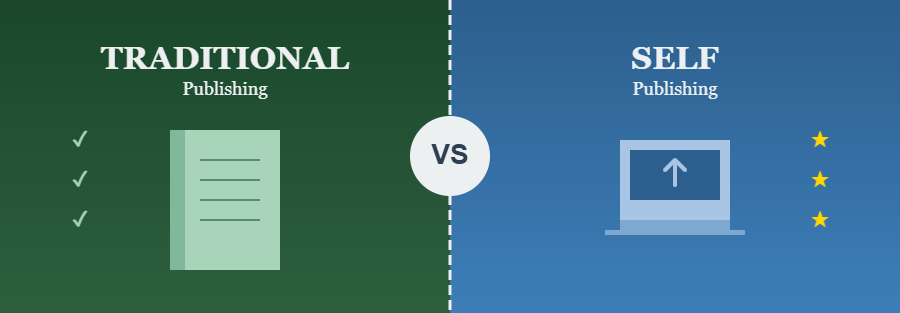
Choosing between self-publishing and traditional publishing depends entirely on your goals, budget, and what you’re willing to sacrifice.
Disclosure: Some links above may contain affiliate partnerships, meaning, at no additional cost to you, Publish and Promote may earn a commission if you click through to make a purchase. You can read our affiliate disclosure in our privacy policy.
After three decades in the publishing industry and helping hundreds of authors bring their books to market, I’ve watched writers succeed brilliantly on both paths, and I’ve also seen plenty of regrets.
Here’s the honest breakdown you need to make the right decision for your book.
Traditional Publishing: The Gatekeeping Route Explained
How it works: You secure a literary agent who pitches your manuscript to publishing houses. If accepted, the publisher handles editing, design, printing, and distribution while you focus on writing.
The Advantages of Traditional Publishing
No upfront costs. Publishers cover all production expenses and pay you an advance (though advances have shrunk considerably in recent years).
Professional team. Access to experienced editors, designers, and marketers who understand the industry.
Bookstore placement. Significantly better chances of getting into Barnes & Noble, independent bookstores, and library systems.
Built-in credibility. The vetting process adds prestige to your work and can open doors for speaking engagements, media coverage, and award considerations.
The Drawbacks of Traditional Publishing
Glacially slow timeline. Expect 2-3 years from acceptance to publication—sometimes longer. Many authors finish writing their next book before their first one hits shelves.
Low royalties. Typically 10-15% of book sales versus 35-70% in self-publishing. On a $20 book, you might earn $2-3 versus $7-14.
Loss of creative control. Publishers make final decisions on titles, covers, pricing, and even content edits. Your book becomes a collaborative product, not solely your vision.
Extremely competitive entry. Securing an agent is harder than getting into Harvard. Most manuscripts get rejected dozens of times—or never find representation at all.
Best for: Authors writing literary fiction, those seeking validation through traditional gatekeepers, writers targeting academic or institutional markets, or anyone who wants publishing handled entirely by professionals and can afford to wait.
Self-Publishing: The Entrepreneurial Author’s Route
How it works: You oversee every aspect—writing, editing, cover design, formatting, distribution, and marketing—using platforms like Amazon KDP, IngramSpark, or Draft2Digital.
The Advantages of Self-Publishing Your Book
Complete creative control. You decide everything from cover art to pricing to marketing strategy. Your vision stays intact.
Higher royalties. Keep 35-70% of sales revenue. Many self-published authors earn more from 1,000 copies than traditionally published authors earn from 10,000.
Speed to market. Publish within weeks or months, not years. Capitalize on timely topics or build momentum quickly.
Full rights retention. You own your work completely—forever. No contract negotiations, no rights reversions, no waiting to get your book back.
Direct reader relationship. You build your own email list and community rather than relying on a publisher’s platform.
The Drawbacks of Self-Publishing
Upfront investment required. Quality editing, professional cover design, and effective marketing cost a minimum of $2,000 to $5,000. Cutting corners shows—and hurts sales.
You’re the marketing department. Without a publisher’s reach (however limited that may be), building an audience falls entirely on you. This requires time, strategy, and often money.
Limited physical bookstore access. Most brick-and-mortar retailers won’t stock self-published books, though this is slowly changing.
Lingering stigma. While diminishing, some readers, reviewers, and literary award committees still view self-published books as lower quality—even when they’re not.
Steep learning curve. You’ll need to understand ISBNs, distribution channels, metadata optimization, and book marketing fundamentals.
Best for: Non-fiction authors with established platforms, genre fiction writers (especially romance, sci-fi, thriller, and mystery), business owners building authority, or anyone who values speed, control, and higher profit margins over traditional prestige.
Self-Publishing vs Traditional Publishing: How to Make Your Decision
Ask yourself these critical questions:
Do you have an existing platform? If you already have an audience—social media following, email list, podcast, YouTube channel, coaching practice—self-publishing lets you monetize that immediately. Traditional publishers increasingly want authors who already have audiences anyway.
What’s your genre? Romance, sci-fi, fantasy, and thrillers absolutely thrive in self-publishing, often outselling their traditionally published counterparts. Literary fiction, serious memoir, and academic works typically benefit more from the credibility and review access of traditional publishing.
Can you invest money upfront? Self-publishing requires capital for professional services. Traditional publishing costs nothing financially but demands years of patience and accepts lower long-term earnings.
How important is speed? Need your book out in six months to capitalize on your expertise or a timely topic? Self-publish. Willing to wait 2-4 years for the traditional publishing experience and validation? Query agents.
What does success look like to you? Be honest. Is it seeing your book in Barnes & Noble? Earning $50,000+ from your book? Getting reviewed in the New York Times? Building a coaching business? Different goals demand different paths.
The Hybrid Publishing Approach: Getting the Best of Both Worlds
Many successful authors now use both routes, traditionally publishing some books while self-publishing others. This approach maximizes income, maintains creative freedom, and builds credibility simultaneously.
For example, you might traditionally publish your literary novel for prestige while self-publishing related workbooks, guides, or genre fiction for income. Or traditionally publish your first book to establish credibility, then self-publish subsequent books to keep higher royalties.
The publishing landscape has evolved beyond the binary choice. Smart authors treat publishing as a career portfolio, not a single decision.
Which Publishing Path Is Right for You?
Your publishing path should serve your specific book and career goals—not someone else’s definition of success.
There’s no wrong choice. There’s only the choice that’s wrong for you and this particular book.
The question isn’t “Which is better?” It’s “Which serves my goals, timeline, and resources right now?”
Ready to bring your book to market with professional quality?
Our self-publishing package handles the technical complexities while you retain full creative control and higher royalties. We guide authors through editing, design, formatting, and distribution—giving you the quality of traditional publishing with the speed and profit margins of self-publishing.
Explore our proven self-publishing services → Publish Your Book
We’ve helped hundreds of authors successfully publish since 2010. Let’s make your book the next success story.